
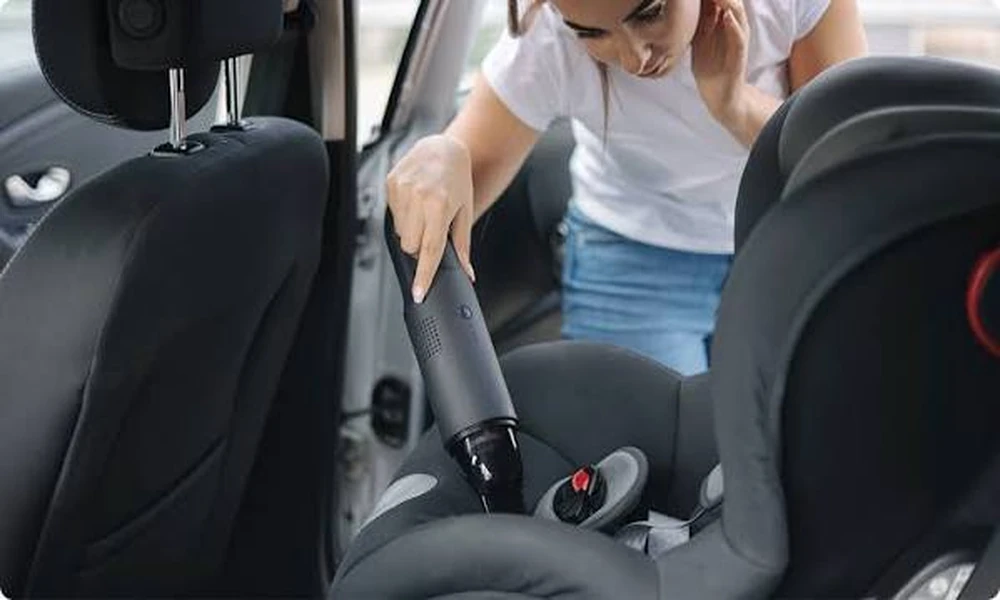
Before booking a detail beneath a child seat, decide who will remove the restraint, who will reinstall it and how the child will travel while that happens. Cleaning the upholstery does not settle those responsibilities. The collection journey deserves its own plan, especially when the person picking up the freshly cleaned car is also expected to collect a child immediately afterwards.
The upholstery and the restraint have different instructions
A child restraint can conceal the part of the back seat that most needs cleaning. Crumbs and spills may be visible around its edges while the upholstery underneath remains inaccessible. That creates a straightforward cleaning question, but it should not become an assumption that everything occupying the seat belongs in the detailer’s usual process. The vehicle seat and the child restraint are separate products with separate instructions.
Describe the requested work as cleaning the vehicle’s upholstery beneath or beside the restraint. If you also want the restraint itself cleaned, identify that as another question and consult its manufacturer. Do not assume that a method suitable for a car carpet belongs on a harness, cover or restraint component. A general interior-cleaning package is not permission to improvise care for a safety product.
Transport Canada’s child-seat installation guidance directs caregivers to understand both the vehicle’s installation instructions and the restraint’s own manual. Those references matter again if a seat is removed for cleaning. A photograph of its earlier position may help someone remember what was present, but it cannot replace the instructions for installing that particular restraint in that particular vehicle.
Keep the distinction visible in the booking. “Clean rear upholstery; caregiver will remove and reinstall the restraint” says something different from “clean everything in the rear.” The first identifies an accessible surface and a responsible person. The second leaves an important gap that a busy household and a busy shop might each expect the other to resolve.
Choose who handles the seat before the appointment
Start with the adult who normally manages the restraint. Can that person prepare the car before it goes to the shop and be available before the next child journey? If another adult will do it, make the responsibility explicit while there is still time to consult the manuals or obtain appropriate help. Do not wait until the restraint is sitting beside a collected vehicle to discover that nobody expected to install it.
When arranging SRS Tints’ cabin-cleaning service in Vaughan, explain whether the back seat will arrive unobstructed or whether the restraint must remain installed. That access decision can shape the cleaning request. A limited clean around equipment you have chosen to leave in place may be more practical than authorising removal without a settled plan for what follows.
Consider storage as part of removal. Know where the restraint and any accompanying parts or instructions will stay while the vehicle is away. They should not become anonymous objects moved between a garage, another car and the shop. Keep the product’s identity and components together in accordance with its instructions, and make sure the adult responsible for reinstallation can find what is needed.
There is no requirement to turn the appointment into a larger project than the household can manage. You might postpone cleaning the covered area, arrange a different date or book only the accessible surfaces. Those are reasonable choices. The important step is choosing knowingly, rather than leaving a safety-related responsibility attached to an undefined promise that somebody will put everything back.
Make the return journey work without a rushed installation
A possible arrangement is for one adult to collect the vehicle alone while another handles the child’s journey in an appropriately prepared vehicle. Another is to collect the car before the child is due to travel and allow a separate, unhurried period for the restraint. These are planning examples, not instructions for installing or transferring a seat. Use an arrangement that fits the actual household and the relevant product requirements.
Work backwards from the child’s next trip. If the vehicle must leave the detailer at the same moment school pickup begins, there may be no useful margin for an installation question. Change the transport arrangement or appointment timing before relying on that sequence. A clean back seat is pleasant; it does not make a compressed collection plan more workable.
Ask the detailer when the cleaned surfaces are expected to be ready for their normal use. If the chosen work involves wet cleaning, discuss the condition at collection and any relevant instructions before fixing the next journey. The caregiver can then consider those instructions alongside the vehicle and restraint guidance. Do not let a general appointment duration stand in for an answer about this car’s readiness.
Keep the child out of a rushed decision at the shop. A waiting child, another appointment and a closing business can create pressure to declare the car ready before an adult has resolved a question. If uncertainty remains, use the alternative transport plan. Arranging that possibility beforehand makes it easier to respond calmly when the timing changes.
Resolve uncertainty before a child travels
Once cleaning is complete, the adult responsible for the restraint should return to the relevant manuals and obtain appropriate installation assistance if needed. This is a separate stage from checking whether a stain remains. The detailer can explain the cleaning performed; the restraint’s correct installation should not be inferred from the fact that the vehicle has been handed back.
Pass the arrangement to any other caregiver who uses the car. Someone collecting a child later should know whether the restraint has been reinstalled and the preparation completed, rather than assuming that a clean cabin means the usual seating arrangement has been restored. A short, direct message can prevent an avoidable misunderstanding between adults.
The vehicle is ready for a child’s journey when the necessary restraint preparation is complete, even if that happens after the car returns home. Treat that moment as its own milestone. It allows the clean upholstery to be enjoyed without making the child’s next ride depend on finishing a safety task against the clock.